
Plenty of investors can tell you what a deal should do. Fewer will show you what it actually did.
At the November Denver Real Estate Meetup, the three people behind one Arvada short-term rental walked through it start to finish. Mike Stone of Threepoint Mortgage was both the investor and the lender. Chad Rocke, an agent with The FI Team, found the property and handled the transaction. Kevin Bevillard, Intentional Living, CPA, handled the tax strategy.
Here’s the story of the deal, from what the buyer was looking for to how the first year has played out YTD (October, 2026).
Chapter 1: What the Buyer Was Looking For
Mike came to Chad with a clear buy box, and it started with cash flow.
“My first focus is always going to be on cash flow. That’s the easiest way for me to quantify exactly what the ROI is going to be”.
His list looked like this:
- Cash flow first. It’s the easiest return to measure.
- Principal paydown. Tenants pay down the loan, another return that’s easy to quantify.
- Appreciation as a bonus. Mike called it “icing on the cake” and leaves it out of his up-front analysis.
- Multiple exits. The property had to work as a short-term, midterm or long-term rental.
- West of I-25. Mike sees better value retention and less competition from new builds there.
- Tax benefits as a bonus, not the goal.
Chapter 2: The Deal That Was Presented
The deal never hit the MLS. Another agent Chad knows sent it to him off market. The owner was running it as an Airbnb and was ready to sell.
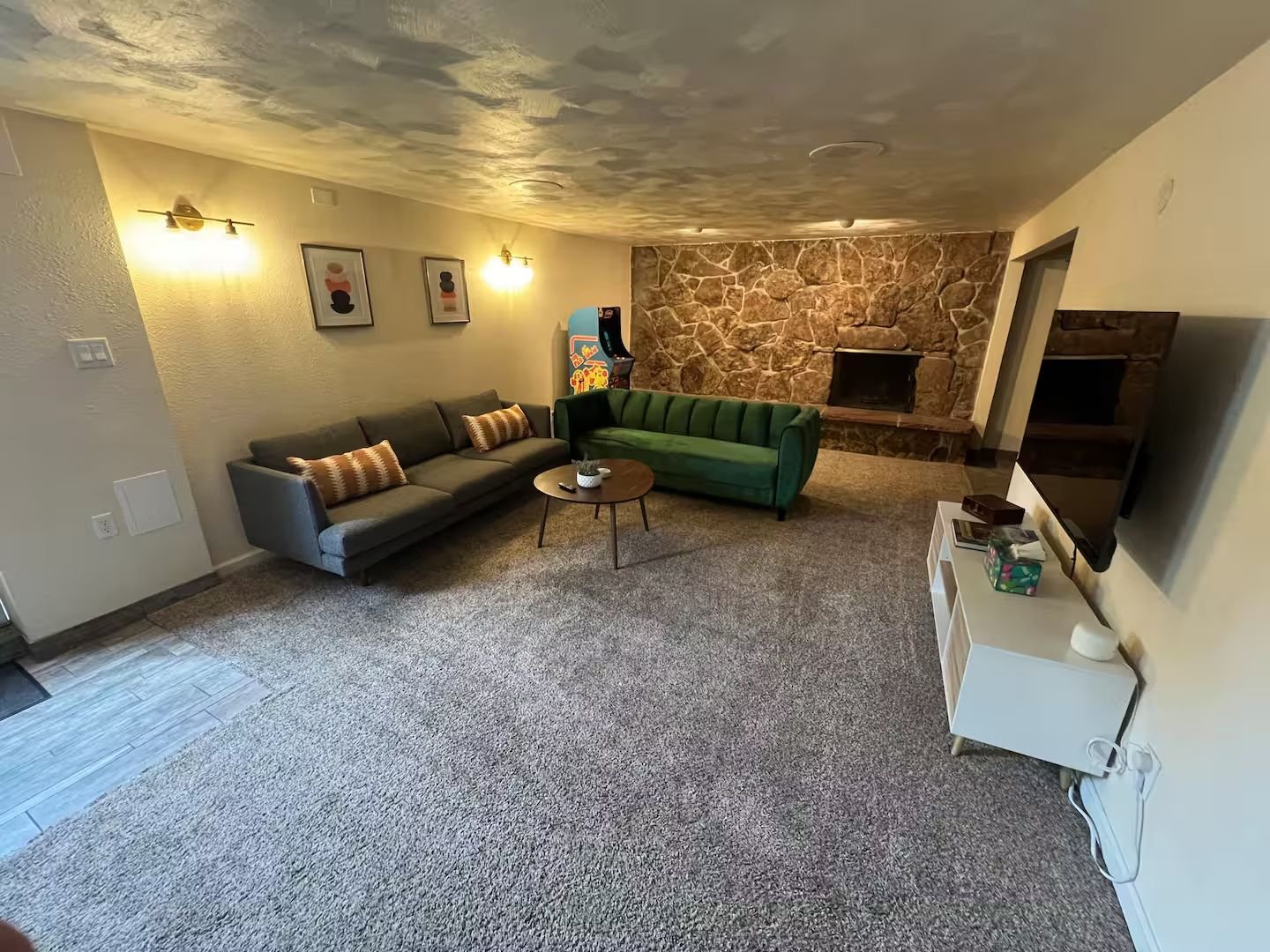
It checked the boxes: a 5-bedroom, 3-bathroom home in Arvada with two kitchens, two living spaces and a lock-off basement with its own entrance. It sleeps up to 10 and sits close to Denver, Boulder, Golden, Olde Town Arvada and Red Rocks.
That layout was the point. A small condo gives you one or two ways to rent it. This home could be rented whole on Airbnb, split into two units, run as midterm rentals or rented long-term.

“Yes, the price is more and your payment is more, but you have way more options for income,” Chad said.
Before going further, the team checked the seller’s Airbnb ledgers against third-party data like AirDNA.
“Who cares what your occupancy is? What if you’re occupied 98% but you’re charging a dollar a night? That makes no sense,” Chad said. “You got to really go through all the numbers.”
Chapter 3: Negotiating Beyond the Price
Instead of pushing the price down, the team structured the offer to lower Mike’s cash out of pocket:
- $740,000 purchase price with $10,000 in seller concessions toward closing costs
- Up to a $10,000 appraisal gap commitment, a contingency, not cash paid. The home appraised at $760,000, so it was never needed.
- A full handoff: furnishings, existing reservations, vendor contacts and the Airbnb listing went to the new owner, so the property could keep operating from day one.
The deal closed on December 26, 2025.
“There’s a lot of money on the table in negotiating with sellers right now, not just through price reductions, but through seller concessions,” Mike said.
Chapter 4: The Financing
Mike used a DSCR (debt service coverage ratio) loan, which qualifies mainly on the property’s rental income rather than the borrower’s personal income. With a tight year-end closing date, he chose a program that allowed a ratio as low as 0.75 with no added rate penalty, in exchange for more money down.
| Financing | Amount |
|---|---|
| DSCR loan (75%) | $555,000 |
| Down payment (25%) | $185,000 |
| Interest rate | 5.875% |
| Monthly payment (PITI) | $3,998 |
| Actual cash at closing | $179,147 |
Cash at closing came in under the down payment because of tax prorations and a transferred security deposit.
Chapter 5: How the Rental Income Worked
The property ran two ways in 2026:
- January to April, midterm: $4,600 a month from two furnished units ($2,800 upstairs and $1,800 downstairs).
- May to October, short-term: an average of $7,711 a month renting the whole home to up to 10 guests, $46,264 in total over six months.
The short-term rental brought in about 68% more per month in gross receipts. It also costs more to run and takes more work to manage.
Chapter 6: The Outcome So Far (January to October 2026)
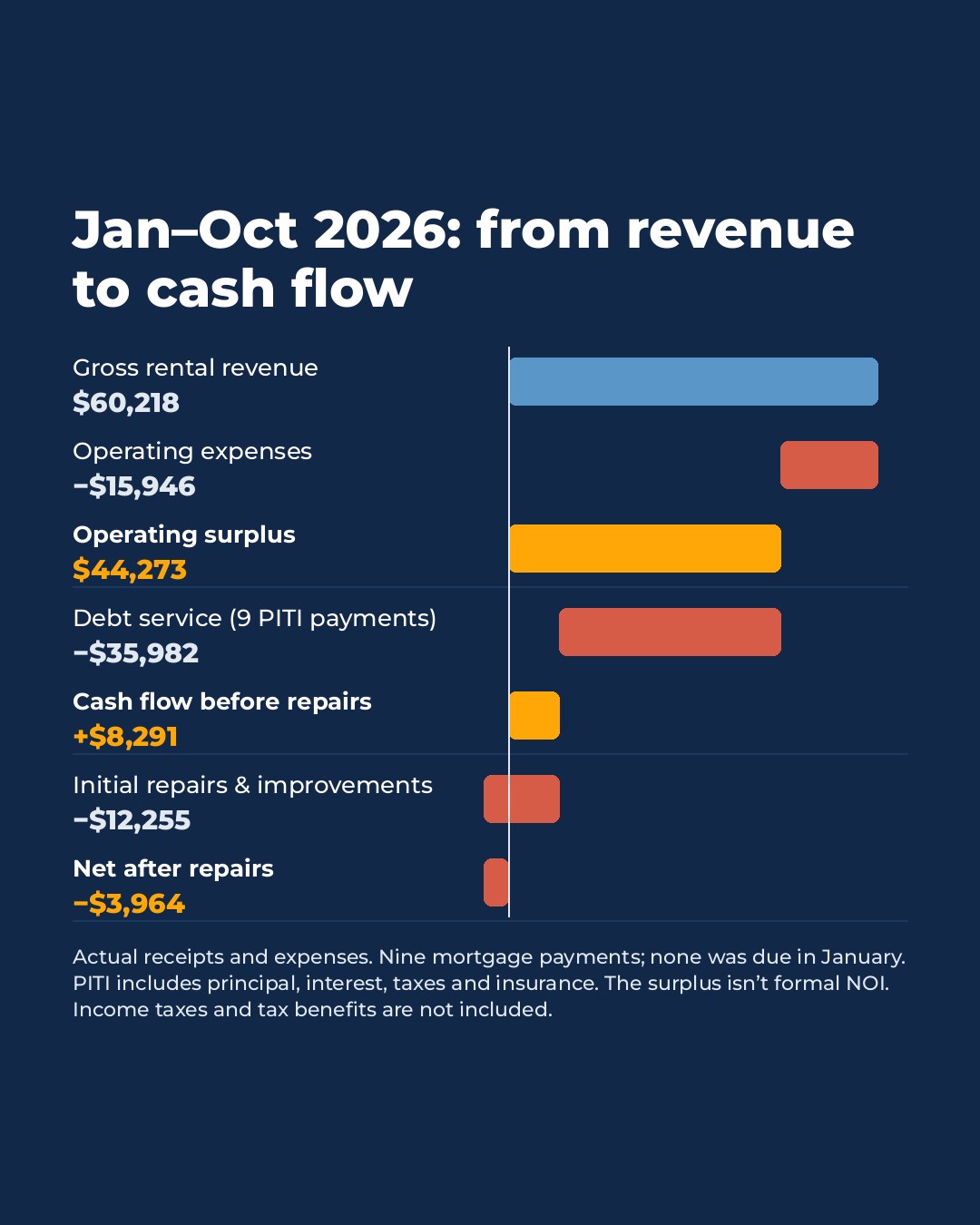
Here’s how revenue turned into cash flow, using actual receipts and expenses:
| January to October 2026 | Amount |
|---|---|
| Gross rental revenue | $60,218 |
| Operating expenses | −$15,946 |
| Operating surplus | $44,273 |
| Mortgage payments (9 PITI payments) | −$35,982 |
| Cash flow before repairs | +$8,291 |
| Initial repairs and improvements | −$12,255 |
| Net after repairs | −$3,964 |
| Mortgage principal paid down | +$5,193 |
No mortgage payment was due in January, so there are nine payments. The operating surplus isn’t formal NOI, and income taxes and tax benefits aren’t included.
As a return, that works out to:
- 5.55% annualized cash-on-cash: $8,291 of cash flow on $179,147 of cash at closing.
- 9.03% annualized cash flow plus principal paydown: $13,484 combined.
Both are annualized from ten months and leave out the one-time improvements. Appreciation isn’t counted.
Turnkey doesn’t mean expense-free
The AC went out in May, right after the switch to short-term rental. Chad referred a contractor who replaced the HVAC for $9,275. Add $1,630 in remediation and $1,350 in roof costs, and year-one improvements came to $12,255. That’s what took the property slightly negative on cash for the year so far.
“Any kind of property, long-term rental, short-term rental, it’s going to take some stabilizing before you can really see what true, somewhat stable returns are going to be,” Mike said.
Chapter 7: The Cherry on Top, Cost Segregation
Cost segregation wasn’t the reason to buy, but it changed the first year. A cost segregation study sorts parts of a property, including the furniture in a furnished rental, into shorter depreciation schedules so deductions come sooner.
“Cost segregation is a way to accelerate your depreciation. You’re not getting more out of thin air,” Kevin said.
- $212,191 depreciation deduction for 2025
- $218,158 total 2025 tax loss on Schedule E
- About $50,000 in illustrative federal tax savings, assuming a simplified 24% rate
To use that loss against other income, the activity had to qualify: an average guest stay of seven days or less, plus material participation by the owner. Loss limits and future depreciation recapture can still apply. The tax savings aren’t rental income and aren’t counted in the cash flow above.
What’s Next for This Property
Year one is about stabilizing. The plan from here is to refine pricing, control expenses, build reserves and evaluate long-term returns.
Takeaways for Your Next Deal
- Underwrite cash flow first. Treat tax benefits as a bonus.
- Buy flexibility. More ways to rent means more ways to adjust.
- Verify the operation, not just the house. Check revenue against third-party data.
- Negotiate beyond price. Concessions can lower your cash in.
- Keep reserves for year one. Turnkey properties still need repairs.
- Talk to your CPA early. “Earlier conversations, the better,” Chad said.
Run Your Own Numbers
Thinking about a short-term rental, a house hack or your next investment property? Reach out! We’d love to hear about your investment goals and join us at the next Denver Real Estate Meetup, where local investors share real deals like this one.
This article is for education only and isn’t tax, legal or lending advice. Figures are actual January to October 2026 results from the presentation. Tax savings are illustrative estimates, not guaranteed. Results from one property don’t guarantee future results.
