If today’s mortgage rates have you thinking, “We’ll just wait until spring,” you’re not alone. Buying a home is a big commitment, and wanting a more comfortable monthly payment makes sense.
But waiting comes with its own uncertainties. Will rates improve? Will prices fall? Will the home you want still be available and how many other buyers will want it?
At The FI Team, we believe studying the market is more useful than trying to predict it. We can help you navigate the conditions in front of you. Nobody can promise what next spring will bring.
One helpful place to start is Denver’s seasonal price pattern.
What Denver’s seasonal data tells us
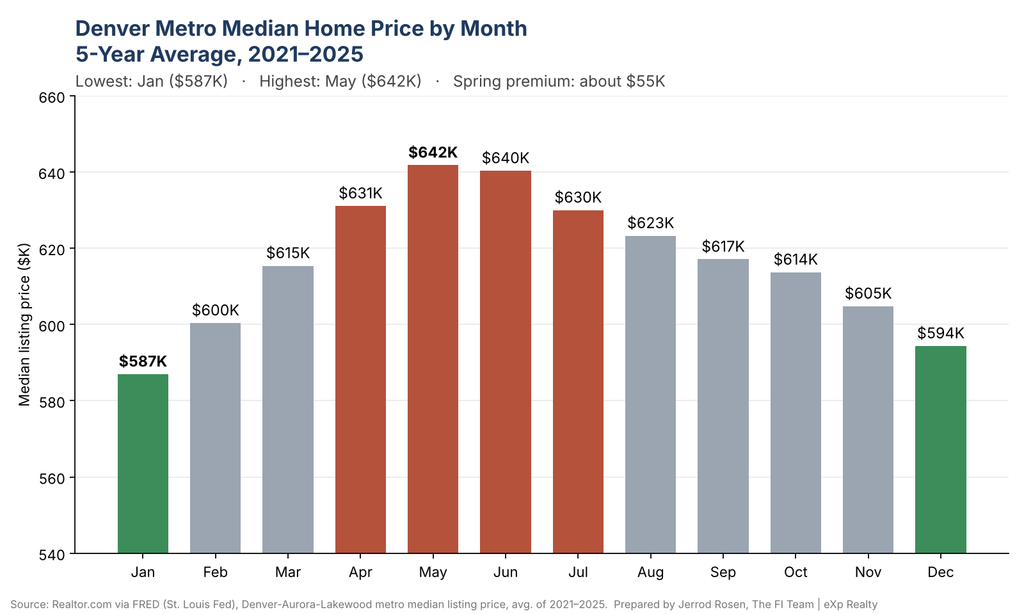
FI Team agent Jerrod Rosen recently shared two charts with his clients using Realtor.com data available through the Federal Reserve Bank of St. Louis. Both track median listing prices in the Denver-Aurora-Lakewood metro area.
Here’s what they show:


| Period | Lowest monthly median listing price | Highest monthly median listing price | Difference |
|---|---|---|---|
| Five-year average, 2021–2025 | January: approximately $587,000 | May: approximately $642,000 | $55,000 |
| 2025 | December: approximately $558,000 | June: approximately $610,000 | $52,000 |
In both charts, asking prices climb into spring and early summer, then soften toward winter.
That doesn’t mean a particular home becomes $55,000 more expensive because the calendar changes. These are market-wide listing medians, and the mix of homes offered for sale changes each month. They also measure asking prices, rather than final sale prices.
Still, the pattern gives buyers valuable context: waiting for spring has historically meant shopping during a higher-priced part of Denver’s annual cycle.
What’s happening in Denver now?
Seasonality is only part of the story. Financing costs, inventory and buyer demand also shape the market.
DMAR’s September 2026 report recorded 13,567 active listings at month-end and 4.76 months of inventory. Closed sales were down 21.39% from a year earlier. Those conditions give prepared buyers more selection and room to negotiate, although opportunities vary by neighborhood, price range and property type.
For someone nervous about rates, that creates a real tradeoff. Financing may feel expensive, while the purchase itself may offer opportunities to negotiate on price, closing costs or other terms.
A fall price reduction deserves investigation. It may reflect seasonal slowing, an ambitious original asking price, broader market softness—or a combination of all three. Comparing the home with recent, nearby sales helps separate those possibilities.
What if rates fall by spring?
Lower rates could improve your payment. They could also bring more buyers back into your search.
How much competition returns would depend on inventory, the economy and local demand. A lower rate doesn’t automatically produce a lower total cost if you pay more for the home or receive fewer seller concessions.
The reverse is also possible: rates could stay elevated or rise, and prices could soften further. Historical seasonal patterns help us ask better questions; they don’t guarantee next year’s outcome.
If you want to test alternative rate environments, check out the Envoy Cost of Waiting Calculator.
Options worth exploring before you decide
You have more choices than buying immediately or putting your search on hold.
- Negotiate seller-paid closing costs. Keeping more cash available after closing may matter more than a small price reduction.
- Compare rate buydowns with other concessions. Ask your lender to show the cost, payment benefit and break-even period. For a temporary buydown, budget for the full payment after the subsidy ends.
- Watch homes with longer market times. Sellers may have flexibility that isn’t obvious from the listing.
- Explore assumable financing where available. Compare the existing loan terms, qualification requirements and cash needed to cover the equity gap.
- Keep refinancing as a possibility. Buy only if the payment works today; a future refinance depends on rates, qualification, equity and costs.
Make a plan around what you can afford today
Waiting may be the right move if you need to build savings, improve credit or clarify your plans. Buying during a slower season may make sense if you find a suitable home, a sustainable payment and favorable terms.
The goal is to understand your options well enough to make a confident decision.
Thinking about buying now versus waiting until spring?
Connect with The FI Team. We’ll compare homes, financing options and realistic payment scenarios so you can make a plan based on your life—and the market we can actually see.